
The high altar and its altarpiece
Liturgical furniture and decoration · altar ensemble

Transcript
From the nave, the end of the choir looks like one great piece of architecture. Let us read it in two stages. First, follow the horizontal line of the table. This is the high altar, the historic main altar of the church. Then let your eyes rise behind it. The decoration standing around the painting has another name. It is the altarpiece.
In the eighteenth century, the marble masons of Matteo Bellandi’s workshop had to design their work from where you are standing. The columns catch the eye from afar. As you look closer, you discover a completely different scale of drawing, that of the veins in each slab of marble. No two follow quite the same path.
Finally, look beyond the altarpiece, towards the pillars of the church. When the marble masons installed their work, these Gothic stones were already old. The two periods meet right there, before your eyes.
Finding the artwork
From the central aisle, look to the far end of the choir. The altar table and the columns framing the painting form the ensemble.
Detail to look for
Compare the lines built by the marble mason with the veins of the stone. The former answer one another regularly; the latter change with every slab.
In brief
A marble altar table and a columned altarpiece bring 18th-century decoration into the Gothic choir.
Learn more
Two works answer each other. One extends horizontally into the choir: the altar table. The other rises behind it: the altarpiece. Its columns frame the painting and make it visible from the nave. This 18th-century decoration fits between Gothic pillars that are much older. From a single viewpoint, you thus discover two moments in the life of the church.
Altar faced with veined marbles over a masonry core. The altarpiece combines columns, an entablature and a carved frame around a canvas. An ensemble imagined for a refurbishment of the choir in the 18th century. The identity of the patrons remains unknown. The Paris workshop of Matteo Bellandi made the marble elements.
- Location
- At the far end of the choir
- Artist or workshop
- Workshop of Matteo Bellandi, marble mason of Italian origin based in Paris, for the marbles of the ensemble
- Date
- About 1735–1755
- Material or technique
- Altar faced with veined marbles over a masonry core. The altarpiece combines columns, an entablature and a carved frame around a canvas.
- Dimensions
- Table, w. 245 × d. 96 cm · altarpiece, h. approx. 6.5 m (fictitious dimensions proposed for the demo)
- History and provenance
- The Paris workshop of Matteo Bellandi made the marble elements. An ensemble imagined for a refurbishment of the choir in the 18th century. The identity of the patrons remains unknown.
- Sources
- Maître-autel de Saint-Joseph-des-Carmes, Paris · Base Palissy, PM75001794 https://pop.culture.gouv.fr/notice/palissy/PM75001794
Fictitious work of the demonstration visit of the church of Saint-Martin. The dating, materials, dimensions and interventions belong to the scenario. The sources document comparable works or practices.
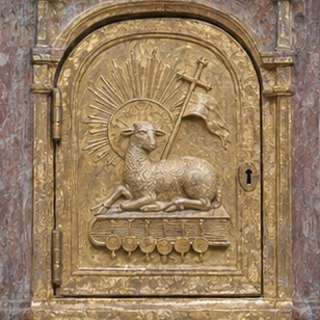 Next stop · 10 of 11The tabernacle with the Mystic Lamb
14on the map