
The pulpit
Preaching furniture · pulpit
Transcript
Pick a seat with your eyes, a few rows from the pillar. Imagine a man climbing the small wooden staircase. With each step, he stands out a little more above the heads. At the top, he turns round, rests a hand on the edge of the pulpit and begins to speak.
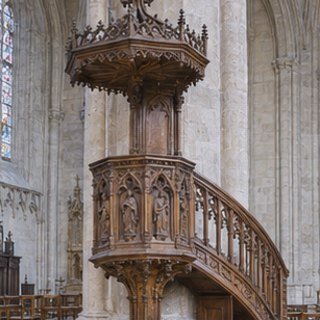
Before microphones, the preacher’s voice had to cross the nave and reach you. Look at the kind of roof hanging above his place. It is the sounding board. Its shape helps send back towards the listeners part of the sound that would otherwise rise into the vault.
In the eighteenth century, the joiner and carver Nicolas Villedieu assembled the oak pieces and gave relief to the panels. You can still see who he was working for. The finest decoration is precisely on the side facing the people who were listening.
Finding the artwork
In the nave, look for the pillar with a wooden staircase winding around it.
Detail to look for
Imagine the pulpit seen from the back row. The preacher’s figure stood out above the heads, even where his words reached the listeners less clearly.
In brief
From the staircase to the sounding board, the whole pulpit is built to carry a voice to the back row.
Learn more
A staircase leads to a small platform attached to the pillar. The preacher climbed up to be seen and heard across several bays. Above him, the sounding board sent part of the sound back towards the listeners. The tub, the staircase and this small roof thus form a single piece of furniture, designed on the scale of the human voice.
Solid oak joined with mortise and tenon. The panels of the tub are carved in relief. A wax finish lets the grain show. Placed in the nave in the 18th century for preaching. Nicolas Villedieu made the joinery and the carved decoration of the pulpit.
- Location
- In the nave
- Artist or workshop
- Nicolas Villedieu, master joiner and carver in Paris
- Date
- About 1730–1750
- Material or technique
- Solid oak joined with mortise and tenon. The panels of the tub are carved in relief. A wax finish lets the grain show.
- Dimensions
- Total h. approx. 4.8 m · width of the tub 1.1 m (fictitious dimensions proposed for the demo)
- History and provenance
- Nicolas Villedieu made the joinery and the carved decoration of the pulpit. Placed in the nave in the 18th century for preaching.
- Sources
- Chaire à prêcher avec abat-voix, Saint-Roch de Faumont · Base Palissy https://pop.culture.gouv.fr/notice/palissy/PM59003500
Fictitious work of the demonstration visit of the church of Saint-Martin. The dating, materials, dimensions and interventions belong to the scenario. The sources document comparable works or practices.
 Next stop · 5 of 11Saint Catherine of Alexandria
6on the map